
How Is AI Automation Changing Jobs Without Replacing Everyone?


"AI automation will actually create far more jobs rather than illimnate them." — Jensen Huang, CEO of NVIDIA
That quote will make some people nod. It will make other people spit out their coffee.
Because if you are a truck driver watching autonomous vehicles roll onto the highway, a warehouse worker watching robots move boxes like they have had three espressos, or a marketer watching AI write 47 LinkedIn posts before you have finished your first sip of tea… "AI creates jobs" can sound less like insight and more like something a billionaire says from a stage while wearing a very expensive leather jacket.

And yet, Huang is pointing at something important.
A few months ago, I was talking with a business owner who said something I hear all the time: "Donald, I know we should be creating more video content. I just don't see the return."
Which is business-owner speak for: "I already paid for a brand video that looked beautiful, made my team cry, got 183 views, and then disappeared into the internet like a sock in a washing machine."
And honestly, I get it. Most companies are not against video. They are against wasting money. They do not wake up thinking, "You know what I'd love today? Another invoice for content my sales team never uses and my prospects never see."
They want leads. They want trust. They want people to understand what they do before the first sales call. They want content that works harder than a motivational speaker at a franchise conference.
That conversation stuck with me, because it is exactly why I built TubeFlex.media the way I did. Most companies do not have a video problem. They have a leverage problem.
They have great ideas trapped everywhere. In sales calls. In customer conversations. In podcasts. In founder stories. In webinars. In random voice notes recorded in the car that start with, "This is either brilliant or I need more coffee."
But those ideas never become a clear, repeatable content system. So what happens? They either do nothing, or they make random content and hope the algorithm wakes up feeling generous.
That is not a strategy. That is digital roulette.
And this is where AI gets interesting.
In my world, AI Automation is not replacing strategy. It is not replacing taste. It is not replacing storytelling. It is not replacing human connection. And it is definitely not replacing the part where a client says, "Can we make it pop?" and everyone stares into the middle distance.
But AI is removing friction. It can help us research faster, test hooks, organize ideas, repurpose long-form content, pull patterns from what is working, speed up editing workflows, and turn one strong message into multiple useful assets.
That does not make the marketer irrelevant. It makes the right marketer more valuable.
The same thing is happening across almost every industry. People keep asking, "What jobs will AI destroy?" But that is the wrong first question. The better question is: "What new capacity does AI unlock?"
Because history shows us something very inconvenient for doomsday predictions: automation usually changes the task before it changes the economy. And once capability expands, new work follows.

When ATMs arrived, people predicted the end of bank tellers. Makes sense. Machine gives cash. Human gives cash. Human loses. Except that is not what happened. Banks became cheaper to operate, so they opened more branches. Tellers shifted away from basic cash handling and into customer service, lending support, and relationship-building.
When elevators became automated, elevator operators disappeared. Which, to be fair, was bad news if your entire career was saying, "Third floor, ladies' shoes." But automated elevators made skyscrapers practical. And around those skyscrapers came offices, hotels, restaurants, security teams, cleaning crews, maintenance workers, leasing agents, engineers, and entire downtown economies.
When tractors automated farming, fewer people were needed in the field. But food production exploded. Costs dropped. Populations grew. New industries formed around logistics, refrigeration, grocery, manufacturing, distribution, equipment, finance, and technology.
So yes, the tractor changed the farm. But it also helped create the modern food economy. Which is why today I can get strawberries in December and pretend that eating them on cheesecake counts as wellness.
Automation changed the task. But expanded capability created new demand.
That is why Huang's point matters:
"AI is the United States's best opportunity to re-industrialize ourselves."

He is not saying every job is safe. Some are not. He is saying AI is not just another software tool. It is becoming an industrial platform. And platforms create ecosystems.
AI needs chips. Chips need fabs. Fabs need construction. Data centers need power. Power needs infrastructure. Infrastructure needs technicians. Robotics need maintenance. AI factories need operators. Software needs engineers. Systems need supervisors. Customers need support. Regulators need compliance.
And every company needs someone who can sit in a meeting and say, "No, we should not replace our entire customer service department with a chatbot named Kevin." That is a real job. Possibly a very important one.
This is not simple job destruction. It is job transformation. And transformation is uncomfortable, especially when you are close to the thing being transformed.
Autonomous transportation is a perfect example. The easy prediction is: "Self-driving trucks will eliminate truck drivers." But that assumes transportation demand stays flat. It assumes the only value in the system is the person behind the wheel. It assumes 100 drivers disappear and one person sits in a dark room watching 100 trucks like a very stressed gamer.
That is too small.
If autonomous fleets make transportation cheaper, safer, and easier to scale, more routes become profitable. More goods move. More warehouses open. More charging stations get built. More sensors need calibration. More fleets need monitoring. More exceptions need handling. More compliance issues emerge. More customers expect faster delivery. More complexity enters the system.
And complexity creates work.

The autonomous transportation economy will need remote fleet operators, AI safety supervisors, sensor technicians, robotics maintenance teams, charging infrastructure crews, route optimization specialists, logistics analysts, compliance managers, dispatch coordinators, software engineers, and probably dozens of roles we cannot name yet.
Try explaining "app developer" to someone in 1985. Try explaining "cloud architect" to someone in 1995. Try explaining "YouTube strategist" to someone in 2003. They would have assumed you were either unemployed or starting a cult.
Every new platform creates a new language of work. And that is what is happening now.
I see the same thing in video marketing. A business owner used to need a huge budget, a full creative team, and weeks of production just to stay visible online. Now, with the right strategy and the right tools, one strong idea can become a YouTube video, a LinkedIn newsletter, a short-form clip, an email, a sales asset, a retargeting ad, a podcast segment, a lead magnet, and probably a quote card that someone will still ask to "make more premium."
AI does not reduce the need for expertise. It increases the need for direction. Because when content gets easier to make, clarity becomes more valuable. When everyone can publish, the winners are not the people making the most noise. The winners are the people who know exactly what problem they solve and can say it in a way customers actually care about.
That is the whole game.
The industrial age paid humans to operate machines. The digital age paid humans to manage information. The AI age will increasingly pay humans to orchestrate systems.
That shift can feel threatening when you only look at the task being automated. But a job is rarely just one task. A great marketer is not just someone who writes captions. A great videographer is not just someone who presses record. A great business owner is not just someone who sends invoices and pretends to understand their CRM.
The value is in judgment, taste, positioning, strategy, trust, and relationships. Knowing what problem to solve. Knowing what message will make someone lean in. Knowing how to turn attention into revenue without wasting time, money, or everyone's will to live.
AI may change the tools. But it does not remove the need for those things. It makes them more important.
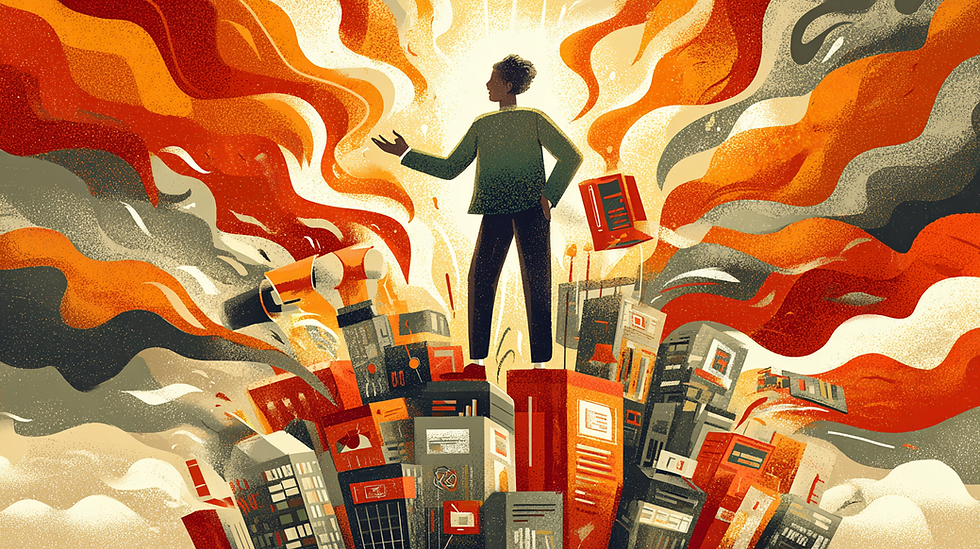
That is why I believe the winners in this next era will not be the people who defend the old way forever. And they will not be the people who panic every time someone posts a robot dog video. The winners will be the people who move from operator to orchestrator.
The warehouse manager who learns AI route planning becomes more valuable. The mechanic who learns sensors and robotics becomes more valuable. The dispatcher who learns fleet orchestration becomes more valuable. The marketer who learns AI-assisted content systems becomes more valuable. The business owner who learns how to use AI without creating complete internal chaos becomes more valuable.
Because the future of work is not humans versus machines. It is humans who know how to guide machines versus humans who refuse to learn.
So maybe the better question is not, "Will AI change my job?" It will. The better question is: "When AI removes the routine parts of my work, what higher-value work will I be free to do next?"
That is the conversation every leader should be having right now. Not fear. Not hype. Preparation.
Because expanded capability tends to create expanded opportunity. But only for the people willing to see it early.
And preferably before Kevin the chatbot gets promoted.
What do you think AI will create more of: unemployment, or entirely new categories of work we have not named yet?


Comments